
THC Vape Guide, UK Vaping News
What Is a Disposable Vape Pen and How Does It Work?
Jul
Intro
The phrase “disposable vape pen” gets thrown around constantly, but if you’re new to THC vaping it raises more questions than it answers. What’s actually inside one? Does it need charging? What happens when it runs out? How does it differ from the cartridge setups you might have seen? This guide answers all of that clearly, without burying you in technical language. By the end, you’ll know exactly how a disposable vape pen works, whether a disposable or reusable setup fits your lifestyle better, and what to look for when evaluating one. For those already familiar with the basics, thcvapestores.uk carries a curated range of lab-tested products with detailed product information for each listing.
Important legal notice: THC-containing cannabis products are controlled substances under the Misuse of Drugs Act 1971 in the United Kingdom, where THC is classified as a Class B drug. Additionally, the sale of single-use disposable vapes in the UK has been prohibited since 1 June 2025. Readers should familiarise themselves with the laws applicable in their jurisdiction before purchasing or importing any such products. Nothing in this article constitutes legal advice or an encouragement to purchase illegal substances.
What a disposable vape pen actually is
A disposable vape pen is a self-contained, single-use device that arrives ready to use straight from the packet. There are no buttons, no charging cables, no refilling, and no settings to configure. You inhale through the mouthpiece, the device activates automatically, and you exhale vapour. When the oil inside runs out or the battery dies, the device is spent. The entire point of the format is simplicity, and it delivers on that in every respect.
The physical form factor is worth noting too. These devices are typically slim, lightweight, and designed to be unobtrusive, though “discreet” is relative and depends on the specific model. Unlike combustion-based methods, there is no flame and no smoke from burning plant material; vapour odour differs from smoke and may dissipate more quickly, though persistence and detectability depend on ventilation and product formulation. For privacy-conscious users, the format is generally well-suited to low-key use.
The all-in-one design unpacked
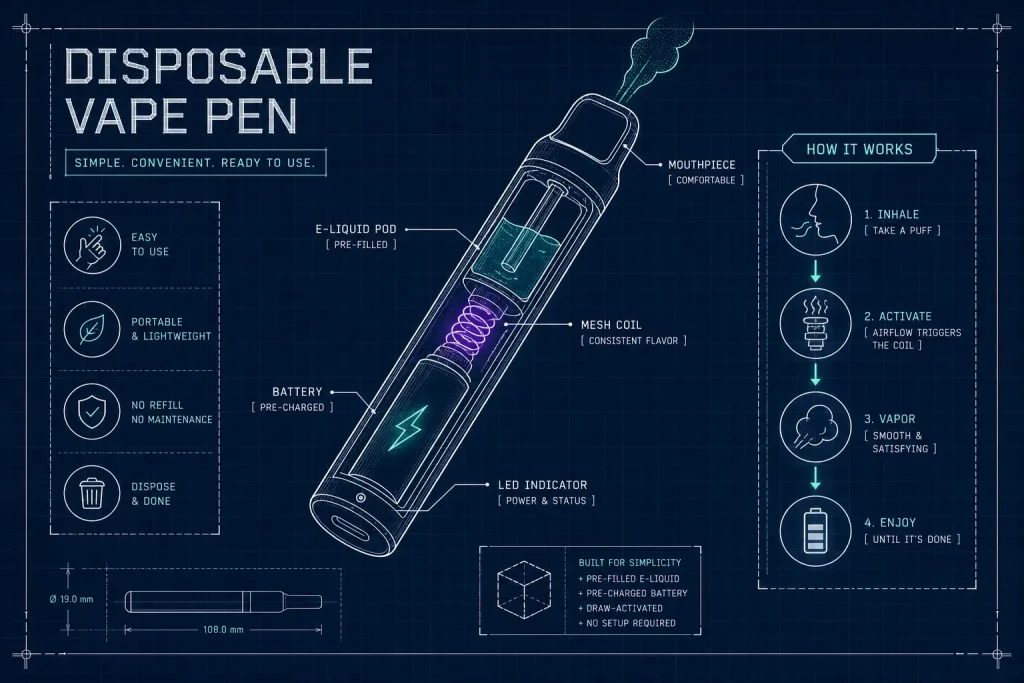
Inside that slim casing sits a pre-filled oil chamber, a ceramic heating coil directly beneath it, and a small lithium battery at the base, all sealed together and topped with a mouthpiece. These components require no assembly or maintenance. The oil feeds directly into the coil, the battery powers the heat, and the mouthpiece channels the vapour. Everything is fixed in place from the moment you open the packaging.
This all-in-one layout is what makes a disposable vape pen so different from cartridge-based setups, where the battery and the oil container are separate units. Understanding this distinction is useful before deciding which format suits you better.


How THC disposables differ from nicotine disposables
Nicotine disposable vapes, familiar brands such as Elf Bar and Lost Mary, were banned from sale in the UK on 1 June 2025 under updated regulations governing single-use devices. THC disposable vape pens operate on the same mechanical principle: draw-activated, sealed, single-use, and offering roughly 600 puffs or more depending on the size. The hardware looks nearly identical. The contents, however, are entirely different. Nicotine disposables contain e-liquid; THC disposables contain cannabis-derived oil, typically a distillate, live resin, or terpene-infused extract. The similarities stop at the casing, and the legal frameworks governing each product diverge considerably further. For more detail on the regulatory change, see this post on the disposable vape ban in the UK.

Geek Bar Pulse – 1 Vape
How a disposable vape pen works
The mechanics are straightforward once you understand the sequence. Inhaling through the mouthpiece creates a drop in air pressure that the device’s internal airflow sensor detects. That signal triggers the battery to send current to the ceramic coil, which heats the oil to vaporisation temperature. The oil vaporises, you inhale the resulting vapour, and when you stop drawing, the sensor cuts the power immediately. The whole cycle takes a fraction of a second.
Draw-activation and the ceramic coil
Because there’s no button, the device fires purely in response to your breath, a design known as draw-activation, which is standard across most quality THC disposable vape pens. The ceramic coil at the centre of this process heats the oil to vaporisation temperature, warm enough to convert the compounds in the oil into vapour without reaching combustion point. This is the fundamental difference between vaping and smoking: no flame, no burning material, no smoke. The absence of combustion is also why the vapour is generally considered cleaner than smoke and why the experience tends to be gentler on the throat, though individual responses vary.
What the vapour actually contains
The vapour that reaches you carries THC, the naturally occurring terpenes present in the oil, and any additional cannabinoids in the formulation. Terpenes are the aromatic compounds responsible for the flavour and aroma of each strain: limonene gives citrus notes, myrcene produces earthy, herbal tones, and pinene delivers the sharp, forest-like quality found in some sativa blends. Beyond flavour, terpenes interact with THC to shape the overall effect, a process commonly referred to as the entourage effect. Ceramic coils are widely preferred in the industry because they heat evenly across their surface, helping to preserve the terpene profile without introducing metallic off-flavours, and they tend to deliver consistent vapour from the first draw through to the last. For a practical explanation of how terpenes influence flavour and effects, see this guide on how cannabis terpenes affect flavour.
Battery life and what “empty” looks like
Many disposable vape pens are designed so that the battery and the oil last for a similar number of puffs, though calibration varies between brands and models. When a device is nearing the end of its life, you’ll typically notice one of three signals: vapour becoming weak or disappearing entirely, a faint burnt taste on the draw, or, on models equipped with one, a blinking indicator light. There is no way to recharge or refill a true disposable. That’s by design, and it’s entirely expected. When the device is spent, dispose of it responsibly via an appropriate WEEE recycling point rather than the general bin, given the lithium battery inside. For environmental considerations and guidance on the impact of discarded devices, see this overview of the environmental impact of vape pens.
Disposable vs reusable: which setup suits you better
This is worth thinking through honestly rather than defaulting to whichever sounds more appealing. Both formats have genuine advantages, and the right choice depends on how often you vape, how much control you want over the experience, and what your budget looks like over time.
Why disposables make sense for beginners
For a first-time THC vape user, the disposable format removes every technical barrier. There’s nothing to configure, no coil to prime, no risk of leaking oil into a bag or pocket. You open it and use it. Disposables are also well-suited to occasional or social use, for trying a new strain before committing to a full cartridge, or for travel where simplicity matters. The upfront cost is low, the experience is immediate, and if you decide vaping isn’t for you, you haven’t invested in hardware you’ll never use again.
When a rechargeable cartridge setup is the smarter choice
For daily users, the cost-per-mg gap between disposables and cartridge-plus-battery setups widens quickly. A rechargeable battery lasts months; individual cartridges can be swapped by strain or potency without replacing the whole device. Cartridge setups, sometimes called rechargeable pod kits or cartridge-and-battery systems, also tend to offer more consistent vapour quality and, in some cases, adjustable voltage for a more tailored experience. If you’re confident you’ll be vaping regularly and want more control over what you’re using, a cartridge setup is the logical next step up from a throwaway vape. For practical buying guidance on refillable systems, consider this piece on how to choose the best refillable pod vape system. If you remain undecided, our comparison article Should you buy a disposable or refillable THC vape pen? explores the trade-offs in more detail.
What to look for when buying a disposable vape pen
Assuming you’ve decided a disposable is the right starting point, the next question is how to choose a good one. Potency, strain profile, and product quality are the variables that actually determine your experience, get those right and the rest follows.
Potency and what the mg numbers actually mean
The number on a disposable vape pen, whether 1,000mg or 2,000mg, refers to the total amount of THC oil in the device, not the amount of pure THC per draw. THC concentration within that oil typically sits in the region of 70, 84% for standard market products, which means a single draw delivers somewhere between 2mg and 6mg of THC depending on draw length and device quality. For beginners, one small draw followed by a 15 to 30 minute wait is a sensible starting approach, you can always take more, but you can’t take less once it’s done. Total cartridge volume does not equal per-puff dose, so treat mg figures as a guide to longevity rather than strength alone.
Strains, terpenes, and choosing your effect
The strain listed on the packaging determines far more than flavour. Indica-dominant oils typically produce a body-focused, relaxing effect, well-suited to evening use or winding down. Sativa-dominant blends lean more energetic and cerebral, better for daytime or social situations. Hybrids offer a balance of both. The terpene profile amplifies these effects and gives each strain its character. A quality disposable vape pen will list both the strain type and the dominant terpenes, choosing a sativa when you wanted evening relaxation, for example, is one of the most common and easily avoidable mismatches.
Choosing the right disposable vape pen: coil quality, oil purity, and lab testing
Not all disposable vape pens are built to the same standard. The difference between a quality product and a substandard one comes down to the coil material and the extraction method behind the oil. Ceramic coils and cleanly extracted distillate or live resin are the benchmarks to look for. Lab-tested products, where THC content, purity, and absence of contaminants have been independently verified and certificates of analysis are available, give you confidence that what’s on the label reflects what’s in the pen. Vague product listings, missing lab data, or unusually low prices are the warning signs worth heeding.
Finding quality disposable vape pen products: what to look for in a supplier
Knowing what to look for in a supplier is just as important as knowing what to look for in the product itself.
What separates a reliable supplier from a poor one
A dependable source will stock disposable vape pens from verified suppliers, display clear product information covering strain, potency, and oil type, and back their products with transparent policies on returns or refunds. Delivery speed matters, and so does packaging. Suppliers who are vague about product origins, offer no customer support, or list products without basic information about what’s inside are ones to avoid. For buyers who value their privacy, discreet shipping practices are worth confirming before purchase.
Why thcvapestores.uk stands out for product information and range
thcvapestores.uk brings together a broad catalogue of disposable vape pen options, including 1,000mg and 2,000mg formats across multiple strains, with detailed product listings and straightforward policies that make evaluating products simple rather than uncertain. Products are lab-tested, listings include strain and potency information, and the range covers options suited to both first-time users and those restocking a strain they already know. Payment options include bank transfer and Bitcoin. Readers should satisfy themselves as to the legal position in their jurisdiction before placing any order. UK buyers looking specifically for reliable domestic suppliers may also find further pointers in this collection: Where can I find reliable disposable THC vapes in the UK?
FAQ: disposable vape pen
What is a disposable vape pen?
A disposable vape pen is a sealed, single-use vaping device that comes pre-filled with oil and requires no charging, refilling, or configuration. You inhale through the mouthpiece to activate it and dispose of the whole unit once the oil or battery is exhausted. For a more general primer on THC vape pens, see What Is a THC Vape Pen? A Complete Guide.
How many puffs does a disposable vape pen give?
This varies by device size and draw length. Entry-level disposable vapes typically offer around 600 puffs; larger 1,000mg and 2,000mg THC formats are designed to last considerably longer, with battery and oil calibrated to run down at a similar rate, though this varies between manufacturers.
Are disposable vape pens legal in the UK?
The sale of single-use disposable vapes in the UK has been banned since 1 June 2025. Additionally, THC-containing vape products are illegal under the Misuse of Drugs Act 1971, where THC is a Class B controlled substance. Readers should seek independent legal advice and understand their local regulations before purchasing or importing any such products. For further reading on the legality of THC vape pens in the UK specifically, see this explainer: Understanding the legality of THC vape pens in the UK.
How do I know when a disposable vape pen is empty?
You’ll typically notice the vapour weakening or stopping altogether, a faint burnt taste on the draw, or a blinking LED indicator on models that include one. There is no way to refill or recharge a true disposable, once it’s done, it should be recycled via a WEEE-compliant drop-off point.
What’s the difference between a disposable vape pen and a cartridge setup?
A disposable vape pen combines battery, coil, and pre-filled oil chamber into one sealed unit that is discarded when empty. A cartridge setup, also called a rechargeable pod kit, uses a reusable battery that you charge separately and pair with replaceable oil cartridges. Cartridge systems generally cost less per mg over time and offer more flexibility, while disposables offer simplicity and zero upfront hardware investment. If you’d like product and system comparisons when choosing a pod or mod, independent resources on best pod mods for vaping can help illustrate the device-side differences.
The short version
A disposable vape pen is the most accessible entry point into THC vaping. Draw-activation means there’s nothing to switch on or configure, the ceramic coil heats the oil without combustion, and the all-in-one design makes the experience immediate and consistent. Whether a disposable or a reusable cartridge setup suits you better comes down to frequency of use and how much control you want over the experience.
Potency, strain profile, and oil quality are the variables that actually determine your experience, get those right and the rest follows. Pay attention to lab-testing credentials, read the strain information, and start low if you’re new to THC vaping. Above all, ensure you understand the legal framework in your jurisdiction before purchasing any THC product.
For those researching their options, thcvapestores.uk offers detailed product listings, lab-tested options, and a range that covers both entry-level disposables and more advanced formats, a useful starting point for informed comparison.
