
THC Vape Guide, UK Vaping News
THC Pen Vape Explained: How It Works & What to Expect
Aug
Introduction
You’ve probably heard someone mention a THC pen vape/THC Vape pen, or seen them pop up in a conversation online, and you’re now wondering what the fuss is actually about. Fair enough. There’s a lot of noise in this space, and not all of it is particularly helpful for someone who just wants a straight answer before deciding whether this is worth trying.
A THC pen vape is one of the more accessible ways to consume cannabis. It’s compact and discreet, with generally less persistent odour than combustion-based methods. But getting started without some basic knowledge is how people end up disappointed, or worse, choosing the wrong product entirely. This guide covers everything you need: how the device works, what’s inside it, how to compare the main types, how to dose sensibly, and what to look for before you buy.
Important legal note for UK readers: Under the Misuse of Drugs Act 1971, THC is a controlled substance in the United Kingdom. Buying, possessing, supplying or importing THC-containing vape products is generally unlawful unless supplied through a prescribed medical cannabis route. The information in this article is provided for harm reduction and educational purposes. If you are considering THC vaping, you should understand the legal position and your personal risk before proceeding. Always consult a qualified medical professional if you are seeking cannabis for health reasons.
What a THC pen vape actually is
At its simplest, a THC vape pen is a compact, handheld device that heats cannabis-derived THC oil until it turns into a vapour you can inhale. The “pen” part comes from the form factor: most devices are slim and cylindrical, roughly the size and shape of a felt-tip pen or a slightly chunky biro. That design makes them easy to carry and use without drawing much attention.
It’s worth clarifying where a THC pen vape sits compared to other devices. It’s not a nicotine e-cigarette, even though the two look similar. The liquid inside is cannabis-derived THC oil, not nicotine e-liquid. It’s also a very different experience from rolling a joint or using a pipe, because there’s no combustion involved at any point.
The basic mechanism: heat, not burn
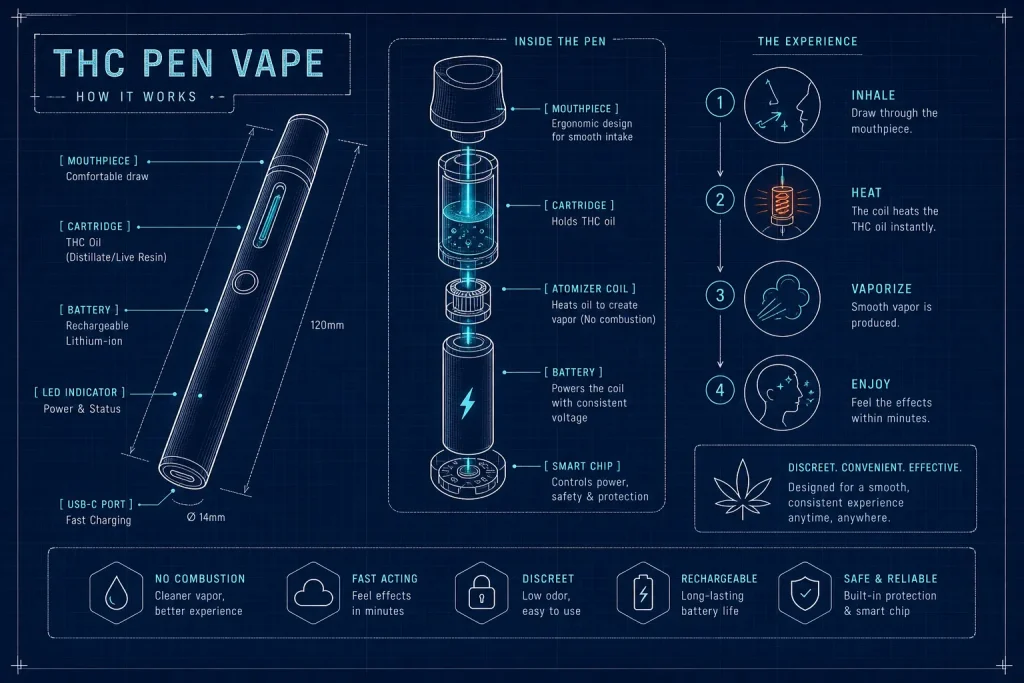
The core principle behind any vape pen is vaporisation rather than combustion. The device heats THC oil to a temperature high enough to convert it into vapour, but not high enough to burn the material. No burning means no smoke, which is why the output is a vapour rather than a cloud of combusted plant matter.
This matters for a few practical reasons. The vapour tends to be smoother to inhale than smoke, the odour dissipates considerably faster, and because nothing is burning, you have more control over what you’re actually inhaling. The basic chain is simple: the battery supplies electrical power, the heating element converts that power into heat, the oil vaporises, and you inhale the result.
The main components inside the device
Understanding what’s inside the device helps you make better purchasing decisions. The battery is the power source, usually a rechargeable lithium-ion cell. The atomiser, often called the coil or heating element, is the component that generates the heat by converting electrical energy from the battery. The oil chamber or cartridge holds the THC concentrate that gets vaporised, and the mouthpiece is where you inhale.
One thing that trips up new users is the difference between draw-activated and button-fired devices. Draw-activated pens use a sensor that detects when you inhale, triggering the heating element automatically. Button-fired devices require you to press and hold a button while you inhale. Most disposable pens are draw-activated, which makes them genuinely straightforward to use straight out of the box.
The two main types: disposable THC vapes vs cartridge systems
Every buyer faces this decision first: do you want a disposable pen or a cartridge system? Both deliver THC vapour. The difference is in how they’re set up and how much flexibility you want. Neither is objectively better; the right choice depends on how you plan to use it.
Disposable THC vapes: the all-in-one option
A disposable is a sealed, self-contained unit. The battery, coil, and oil come pre-loaded in a single device. You don’t need to buy anything separately or set anything up. Some modern disposables include a USB-C charging port so you can use every last bit of oil before the device is finished, which addresses the old complaint about batteries dying before the oil ran out.
A typical 1ml disposable delivers somewhere in the range of 200 to 300 puffs, though draw length and device voltage both affect this figure. The appeal is obvious: zero setup, easy to carry, and when it’s done, you’re done. The downside is that you’re paying for the hardware every time, which makes the cost per gram of oil higher over the long term.
THC cartridge vape systems: the flexible alternative
A cartridge system splits the hardware into two parts: a reusable battery and a replaceable cartridge containing the oil. Most cartridges use a 510-thread connection, a standardised screw fitting that works with the majority of reusable batteries on the market. Once you own the battery, you only replace the cartridge when it runs out.
The financial logic is straightforward: the upfront cost is higher because you’re buying the battery separately, but over time, paying only for cartridges is cheaper per gram of oil than buying a new disposable each time. Cartridge systems also give you more control. Many reusable batteries have adjustable voltage settings, which lets you dial in the vapour temperature to suit your preference for flavour or intensity. That matters more once you know what you’re doing.
Which one suits you as a beginner?
If you have no existing kit and you’re trying a THC pen vape for the first time, start with a quality disposable. Fewer variables means fewer chances to get it wrong. Once you’re comfortable with how the experience feels and how much you’re using, stepping up to a cartridge setup makes practical sense from both a cost and flexibility standpoint.
Understanding THC strength and how to dose safely
The numbers on THC vape packaging confuse a lot of new users. A label saying “80% THC” or “1000mg” doesn’t tell you much on its own unless you understand how to apply it. Getting this right is the difference between a good experience and an overwhelming one.
What 70% to 95% THC actually means in practice
THC vape oils typically contain between 70% and 95% THC by weight, with distillate products sitting at the higher end of that range. To put that in concrete terms: a 1ml cartridge at 80% THC contains roughly 800mg of THC in total. A single puff, depending on draw length and device output, delivers an estimated 2 to 5mg of THC, a figure consistent with widely cited industry testing ranges, though the actual amount varies with draw duration, device power, and formulation. That might sound small, but it adds up quickly if you’re taking consecutive puffs without pausing.
You’ll also come across live resin cartridges, which tend to test lower in THC (around 60% to 85%) but retain more of the plant’s natural terpenes. Many users find live resin delivers a more rounded, flavourful experience compared to the sharper, more potent hit from a high-percentage distillate. Neither is superior; they suit different preferences.
A sensible starting approach for new users
Start with one or two short puffs and wait at least 15 minutes before taking more. Inhalation delivers effects within minutes, but the full effect takes a little longer to settle, and overconsumption is very easy to do when you’re not familiar with the product. Experienced users can work up to three to five puffs as needed, but the principle stays the same: start low, go slow, and adjust once you know how your body responds.
If you’re completely new to THC, consider starting with a lower-potency product. Not every cartridge or disposable needs to be 90%+ THC. A mid-range option gives you more room to find your footing without the risk of taking too much in one go.
Safety, side effects and what to watch out for
Being informed about risks isn’t scaremongering; it’s just good sense. THC vape pens are straightforward to use when you understand what you’re working with, but there are genuine risks associated with both the substance and the product if you’re not careful about what you buy.
The real risks: what the evidence shows
Overconsumption is the most common issue. High-potency oil delivered quickly makes it easy to take more than intended, leading to anxiety, paranoia, dizziness, or nausea. These effects always pass, though they’re unpleasant and entirely avoidable with sensible dosing. More serious is the risk associated with unregulated or counterfeit cartridges. The EVALI outbreak in 2019 was strongly linked to illicit THC cartridges containing vitamin E acetate, a diluent used in black-market products. The source of your cartridge matters enormously from a health perspective.
Repeated heavy use also carries longer-term concerns around respiratory irritation and cognitive effects, particularly for younger users. These aren’t reasons to avoid THC pen vapes entirely, but they are reasons to use them with awareness rather than treating them as consequence-free.
Practical harm reduction for anyone who vapes THC
The most important step you can take is buying only from vendors who provide verifiable lab testing. Don’t modify your device, don’t mix in other liquids, and don’t use unlabelled or informal-market cartridges. Space your puffs out, choose lower-potency options if you’re new, and where possible avoid heavily flavoured products, as public health guidance notes that flavouring compounds can introduce additional additives into aerosols that are not fully characterised for inhalation safety.
If you experience chest pain, a persistent cough, shortness of breath, or wheezing after vaping, stop using the device and seek medical attention promptly. Tell your GP or doctor that you’ve been vaping and describe the product as accurately as you can; that information helps with assessment and treatment. Anyone who is pregnant, has a history of psychosis or severe anxiety, or has significant respiratory or cardiovascular health concerns should avoid THC vaping altogether.
How to buy a lab-tested THC vape with confidence
Knowing what a good product looks like before you spend money is just as important as knowing how to use it. The UK market includes both conscientious vendors and operators who rely on buyers not asking the right questions. Given the legal position on THC products in the UK, it’s also important to understand what you’re purchasing and from whom before you commit.
What a lab-tested THC vape product actually looks like
A Certificate of Analysis (COA) is the document from an independent laboratory that confirms what’s actually in the oil. A legitimate COA should include the lab’s name and accreditation details (look for ISO/IEC 17025 accreditation), the batch or lot number, the test date, cannabinoid potency results, and a full contaminant panel covering residual solvents, pesticides, heavy metals, and microbials. A COA that only shows a THC percentage tells you nothing about what else might be in the oil.
To verify a COA is genuine, match the batch number on the document to the number on the packaging. Use the QR code or report number to check the record directly on the lab’s own website, not just the brand’s page.
If a vendor can’t point you to a real, named, accredited lab with batch-specific results, that’s a meaningful red flag. A partial COA showing only potency with no contaminant testing is a weaker safety signal for any vape product.
Why choosing the right vendor matters
A trustworthy vendor is transparent about their products, attaches lab results to individual items, prices things clearly, and makes it straightforward to get help or raise an issue. When evaluating any vendor, look for these practical signals: product-specific COA links, clear pricing with no hidden costs, a stated returns policy, and accessible customer support. These are the markers of a vendor that takes the post-purchase experience as seriously as the sale itself.
thcvapestores.uk carries a range of THC pen vapes, disposables, cartridges, concentrates, and accessories for UK customers, with product descriptions intended to help buyers understand what they’re choosing. As with any vendor in this space, buyers should independently verify product COAs, check that lab results are batch-specific, and satisfy themselves that any purchase aligns with their own legal and personal risk assessment.
Where to go from here
At this point you’ve got enough to make a considered call and avoid the most common mistakes new buyers make. You understand how a THC vape pen works mechanically, the difference between disposable THC vapes and cartridge systems, how to read potency figures and dose sensibly, and exactly what to look for in a lab-tested THC pen vape before handing over any money.
Used carefully, a THC vape pen is one of the more controllable and discreet cannabis consumption methods around. The key is understanding the legal context in the UK, buying from a vendor you can verify, starting at a lower dose than you think you need, and giving yourself time to understand how your body responds before pushing further.
When you’re ready to explore what’s available, browse the range at thcvapestores.uk and drop the support team a message if anything’s unclear before you commit.
